
Connecting links, offset links and getting the length right
Spring clip or cotter? Even or odd pitch count? Why did the offset link break first? The questions the box never answers.
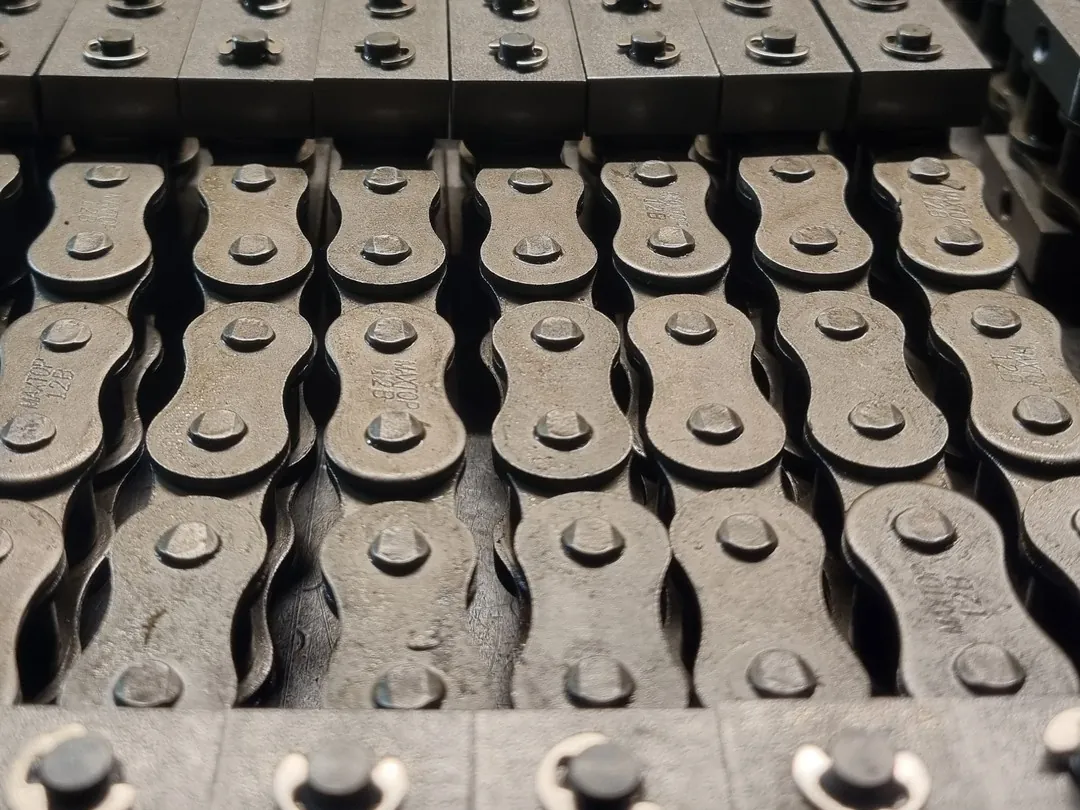
A chain is only as good as its joint
Chain looks like a commodity until you have to join it. Then the questions start: spring clip or cotter pin? What happens when the length comes out at an odd number of pitches? Why did the offset link break first? This guide answers the questions the box never does, and explains why we supply chain made up to your exact pitch count rather than leaving you a hacksaw and a guess.
How chain is supplied
| Format | What you get | Best for |
|---|---|---|
| Boxed lengths | 10 ft or 5 m per box (e.g. 40 × 10FT, 08B × 5M) | Stock drives and general workshop use |
| Reels | Long continuous lengths (e.g. 25 × 100FT reeled) | OEMs and workshops cutting their own |
| Cut to length (our speciality) | Cut to your exact pitch count and assembled to specification, connecting link fitted | The right length, first time, with no joining on the machine |
Spring clip or cotter pin?
A connecting link closes the chain into a loop. There are two standard types, and the split is by pitch:
- Spring clip type — the standard fitment up to and including 3/4″ pitch; it is what goes in the bag unless you ask otherwise. The detachable plate slips onto the pins and a sprung clip retains it. Quick to fit; make sure the clip's closed end faces the direction of travel.
- Cotter pin type — used on the larger pitches (1″ and up), where the plate is retained by split cotter pins: more secure at the loads big chain carries, and available on the smaller sizes too if you prefer it.
Both are slip-fit plates. That makes them serviceable, but on heavily loaded or high-shock drives, a riveted endless chain (permanently pressed and riveted) removes the joint as a weak point altogether.
We stock roller chain extractors covering 6.35–19.05 mm pitch (small) and 19.05–31.75 mm pitch (large), for BS and ANSI series. They are the right tool for splitting chain cleanly without mushrooming the pins.
The pitch-count question
Chain joins neatly when the total number of pitches is even: inner and outer links alternate perfectly and a standard connecting link closes the loop. An odd count needs a cranked (offset) link to make up the difference. Here are the supply options for each:
Even pitch count
| Option | What it means | Use when |
|---|---|---|
| Connecting link supplied loose | Chain plus a separate connecting link; you join it on the machine | The default for most replacements |
| Connecting link fitted one end | Link already attached to one end, ready to wrap and close | Faster fitting in awkward positions |
| Endless, connecting link installed (A.E.) | Supplied as a closed loop, joined with a connecting link | Where the loop can be fed onto the drive |
| Endless, riveted (R.E.) | Supplied as a permanently riveted closed loop | Maximum-security joint for demanding drives |
Odd pitch count
| Option | What it means | Use when |
|---|---|---|
| Connecting link + offset link one end | An offset (cranked) link makes up the odd pitch | The standard answer to an odd count |
| Connecting links both ends | Joinable at either end | Special fitting situations |
| Roller link each end (RLEE) | No connecting links; inner links both ends | You supply or fit the joining links |
A warning about offset links: a single-pitch offset link uses a slip-fitted, cottered pin, and on demanding drives it is reliably the first thing to break. Broken offset-link pins are a recognised failure mode, and the standard remedy is: don't use them. If your length comes out odd, prefer a two-pitch offset link (press-fitted and riveted, far stronger), or better still, tell us the centre distance and we'll advise whether a small adjustment gets you to an even count.
The right count, the right link, first time
All of the above is why our made-to-measure service exists. Tell us the pitch count, or send the old chain and we'll count it, and the chain arrives:
- Cut to the exact count from bulk coil (08B-1, 10B-1, 12B-1, 60-1, 60-1H held in 150 ft+ coils)
- With the correct connecting link fitted, spring clip or cotter to suit the pitch
- With a two-pitch offset engineered in only where an odd count is unavoidable
- Bagged, labelled, and held on file so the reorder is identical
When fitting a spring-clip connecting link, the closed end of the clip should face the direction of chain travel, so nothing on the machine can catch the open end and flick it off.
Straight answers
What is a connecting link on a roller chain?
The link that closes the chain into a loop. Spring-clip type is the standard fitment up to and including 3/4 inch pitch — it is what goes in the bag unless you ask otherwise. Cotter-pin type is used on the larger pitches (1 inch and up). Both use a slip-fitted plate so the chain can be split for service.
What is a cranked or offset link?
A link that makes up an odd number of pitches, where inner and outer links can no longer alternate evenly. Single-pitch offset links use a slip-fitted cottered pin and are a known weak point. Two-pitch offset links are press-fitted and riveted, and far stronger.
Should my chain have an even or odd number of pitches?
Even, wherever possible. The chain joins with a standard connecting link and no offset. If your centre distance forces an odd count, use a two-pitch offset link, or ask us: a small adjustment to the drive often gets you to an even count.
What is endless or riveted chain?
Chain supplied as a permanently closed loop, with the joint pressed and riveted rather than slip-fitted. It removes the connecting link as a weak point, so it is the choice for heavily loaded or shock-loaded drives where the loop can be fitted over the machine.
Do you sell chain breakers?
Yes. Roller chain extractors in two sizes covering 6.35 to 19.05 mm and 19.05 to 31.75 mm pitches, for BS and ANSI chain, from UK stock.
Just tell us the count
Or send the old chain and we will count it. The new one arrives made up, joined correctly, and on file for next time.