
Self-lube chain that runs without oiling
An oil-impregnated bush lubricates the joint from the inside. No oiler, no drips, no maintenance regime, and NSF H1 registered for food lines.
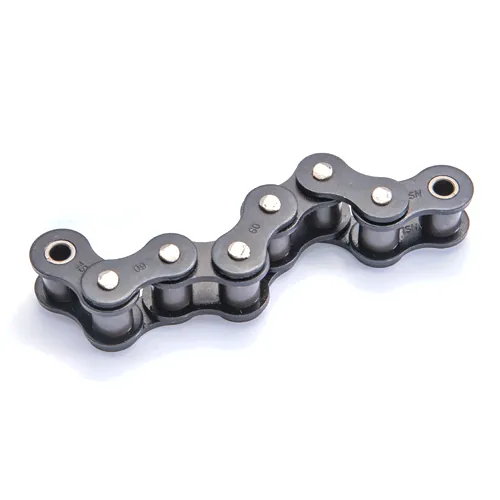
The chain that lubricates itself
Every roller chain joint is a bearing, and bearings need oil. But on plenty of drives, oiling is the problem: the chain runs over food, the joint is unreachable, the line can't stop for maintenance, or the oil simply attracts the dust that then destroys the chain.
Self-lube chain solves it at the joint. The bush is oil-impregnated: a porous, oil-filled bearing that releases lubricant slowly into the pin as the chain articulates, and draws it back as it relaxes. The result is a chain that runs without relubrication, without drips, and without an oiling regime to forget.
The lubricant is NSF H1 registered, the standard for lubricants where incidental food contact is possible. That is why NSL suits food, packaging and pharmaceutical lines as well as unreachable drives.
Sizes, strength & speed limits
Self-lube chain has a maximum recommended running speed. Beyond it, the joint can't replenish fast enough. The limits are published here rather than buried.
| Chain | Pitch (mm) | Ultimate strength (kgf, ave.) | Max recommended speed (m/min) |
|---|---|---|---|
| 40NSL | 12.70 | 1,850 | 150 |
| 50NSL | 15.875 | 3,100 | 135 |
| 60NSL | 19.05 | 4,300 | 120 |
| 80NSL | 25.40 | 7,700 | 90 |
| 100NSL | 31.75 | 11,500 | 80 |
| 120NSL | 38.10 | 15,000 | 50 |
| 08BNSL | 12.70 | 1,900 | 150 |
| 10BNSL | 15.875 | 2,600 | 135 |
| 12BNSL | 19.05 | 3,200 | 120 |
| 16BNSL | 25.40 | 7,400 | 90 |
Two specifications: FG (standard) NSF H1 bush, -10°C to 145°C · FGH (optional) NSF H1 bush, -20°C to 220°C for ovens, fryers and heat tunnels. Chains use nickel-plated pins and black-oxide plates as standard; other corrosion protection on request. Duplex versions available in all sizes. Straight-link-plate versions (GL / F series) available. Supplied to order — contact us for current lead time.
No oiler, no drips, no regime
- Food & packaging lines. NSF H1 lubricant, no oil dripping onto product
- Ovens, fryers and heat tunnels. FGH specification runs to 220°C
- Unreachable drives. Inside machines, guards, or at height
- Dusty environments. No surface oil to attract abrasive dust into the joint
- Lines that can't stop. No scheduled relubrication to plan around
Self-lube chain has a maximum running speed and costs more per metre than standard chain. On an accessible, well-oiled drive running fast, standard chain is the better buy, and we'll say so.
Straight answers
How does self-lube chain work without oil?
The bush is porous and oil-impregnated, effectively an oil-filled bearing. As the chain articulates it releases lubricant onto the pin, and draws it back as the joint relaxes. There is no external oil film, so nothing drips and nothing attracts dust.
Is self-lube chain food safe?
The impregnated lubricant is NSF H1 registered, the standard for lubricants in food-processing environments where incidental contact is possible. The FG specification runs from -10 to 145 degrees C, and the FGH from -20 to 220 degrees C.
Does self-lube chain last as long as oiled chain?
On a well-maintained, properly oiled drive, conventional chain is hard to beat and costs less. Self-lube wins wherever oiling is impractical, unwanted or forgotten, which covers a great many drives. It also has a maximum running speed, published in the table above.
Can I get it in duplex or with straight plates?
Yes. Duplex versions across the range, and straight-link-plate versions where a flat running surface is needed.
Drive you can’t oil?
Tell us the duty, the speed and the temperature and we will tell you whether self-lube is the right answer.