
Chain fault finding: what your failure is telling you
Cracked plates, stiff links, chain climbing the teeth: each failure has a cause, and fitting a new chain without fixing it just buys the same failure again.
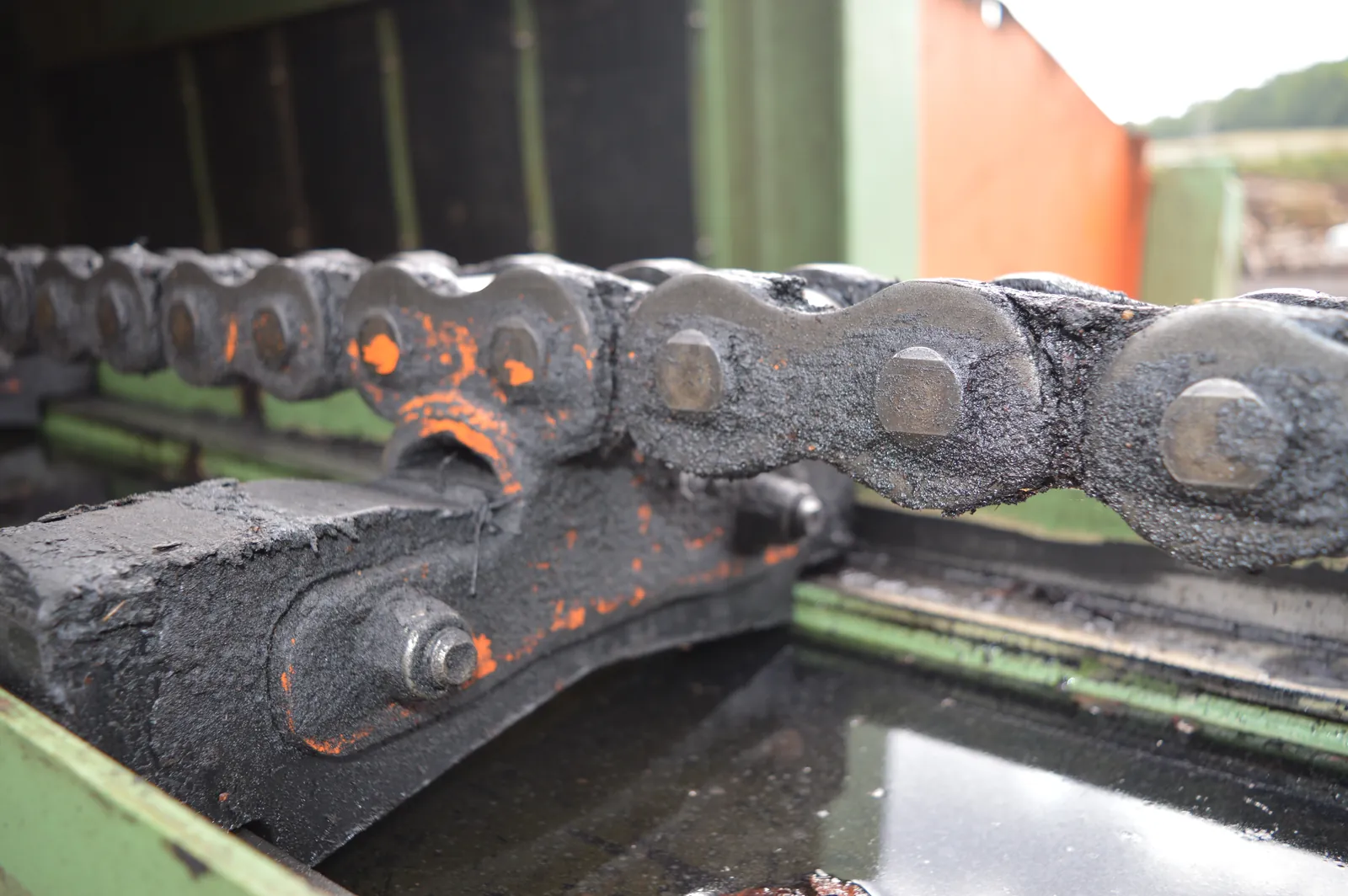
A failed chain is evidence
Chains rarely fail for no reason. The way a chain fails tells you why it failed, and if you fit a new one without reading that evidence, the new chain will fail the same way. Cracked plates are a different problem from stretched joints; a chain that climbs the teeth is telling you something different again.
Use the table below to work from the symptom back to the cause. If you're not sure what you're looking at, photograph the failure and send it to us. We read worn and broken chain every week, and we'll tell you whether the fix is a new chain, a better specification, or something on the machine itself.
Symptom, cause, remedy
The common failure modes in roller chain drives, and what each one is telling you.
| Symptom | Likely causes | What to do |
|---|---|---|
| Excessive noise | Sprockets misaligned · too much or too little slack · chain fouling a guard or guide · loose chain guard or bearing · poor or no lubrication · chain pitch too large for the drive | Re-align sprockets and shafts · adjust centres or take-up · find and remove the obstruction · tighten fixings, check bearings · establish proper lubrication · review the chain selection |
| Chain vibration or whipping | Too much slack · centre distance too long · stiff links | Adjust the tensioner · fit an idler · lubricate or replace the chain |
| Chain climbs the sprocket teeth | Excessive slack · inadequate lubrication · overload | Fit a tensioner · lubricate · reduce the load, or move up to a stronger chain |
| Chain has gone stiff | Inadequate lubrication · corrosion · excessive load · misalignment | Clean the chain and establish correct lubrication · move to a corrosion-protected chain · reduce load or fit a suitable-strength chain · re-align sprockets and shafts |
| Wear on the inside of the link plates, and one side of the sprocket teeth | Misalignment; this is the classic signature | Re-align sprockets and shafts; replace chain and sprockets together if wear is advanced |
| Galling on pins and bushes | Overload · inadequate lubrication | Correct the lubrication · replace the chain once elongation passes the functional limit |
| Fractured link plates | Extreme overload or shock loading | Inspect the drive to find the source of the high load; consider heavy-series or higher-capacity chain |
| Broken pins | Extreme overload | Inspect the drive for the cause; redesign with a higher-capacity chain |
| Broken offset-link pins | Overload | Single-pitch offset links are not recommended for demanding drives. Redesign using a higher-capacity chain and an even pitch count |
| Turned pins | Overload · inadequate lubrication | Replace the chain as soon as possible · reduce shock loading or fit a stronger chain · lubricate properly |
| Fatigue failure | Extreme or repeated overload | Inspect the drive; redesign using a higher-capacity chain. This is where heavy-series chain earns its keep |
| Cracking (unusual, brittle-looking cracks) | Stress-corrosion cracking | Protect the chain from the corrosive environment, or specify an anti-corrosion / stainless steel chain |
| Broken rollers | Foreign material trapped between chain and sprocket tooth · fatigue | Shield the drive from debris · review chain speed and load |
| Worn plates (wear on the bottom edges) | Plates rubbing on guides or tracks | Replace the chain once wear exceeds about 5% of plate height |
| Uneven elongation of two parallel-running chains | The pair was not matched on length when fitted · one chain lubricated or loaded more than the other | Replace as a matched pair, cut to the same length from one batch. Never renew one side alone; on wire-belt and twin-strand drives we supply matched pairs as standard |
| Wound or opened rollers (roller material peeling or unravelling) | Roller running against an abrasive product or misaligned guide · under-lubrication letting the roller skid rather than roll | Shield the roller path from abrasion · correct alignment and lubrication · consider a plastic-roller or non-marking chain where the roller contacts product |
| Discolouration of the chain (blue, straw or dark bands) | Overheating from friction — almost always a lubrication or overload problem · or heat from the process itself | Establish correct lubrication and check for binding · for genuine high-temperature duty specify a heat-rated chain (self-lube FGH runs to 220°C) rather than accepting the discolouration |
| One-sided wear of rollers, bushes and the inner plates | Sprocket and shaft misalignment, the same root cause as angled tooth wear | Re-align sprockets and shafts with a straightedge; replace chain and sprockets together where wear is advanced |
| Open or broken connecting links | Spring clip fitted backwards or dislodged · connecting link under-specified for the drive · vibration working the clip loose | Fit the spring clip with its closed end facing the direction of travel · on demanding drives use a riveted endless joint instead of a slip-fit link — see Links, lengths & odd pitch counts |
| Rust and corrosion | The environment is attacking an unprotected chain: washdown, damp store, chemical exposure | Move to a coated, stainless steel or self-lube specification matched to the environment — see the corrosion coating comparison |
Two related guides: how to measure chain wear (chains are worn out at 1.5–2% elongation) and standard vs heavy-series chain (the right answer for cracked plates, the wrong answer for wear).
Nearly every chain failure traces back to one of these
Whatever the symptom, the underlying cause is usually one of four things, and three of them are free to fix:
- Lubrication. The pin–bush joint is a bearing. Run it dry and it machines itself. The single most common cause of short chain life.
- Misalignment. Shows as wear on the inner faces of the plates and one side of the sprocket teeth. Costs nothing to check, ruins chains quietly.
- Overload or shock. Cracked plates, broken pins, fatigue. The chain is the messenger, not the culprit. Find what's loading it.
- Contamination. Grit, bark, dust and swarf act as grinding paste in the joints. If the environment can't be cleaned, the chain specification can be changed.
Photograph the failed section next to a rule, plus the sprocket teeth if you can. We'll tell you what failed and why, and if a cheaper standard chain would do the job, we'll say so.
Straight answers
My chain keeps stretching. Should I fit a stronger one?
Probably not. Elongation is wear in the pin and bush, and a heavy-series chain has the same pins and bushes, so it wears at the same rate. Fix the lubrication, alignment or contamination first, or move to a sealed, self-lubricating or corrosion-protected specification.
The plates on my chain are cracking. What does that mean?
Cracked or fractured plates point to overload or shock loading, not wear. That is the failure heavy-series chain is designed to resist: thicker plates give far better fatigue and impact resistance. Send a photo and we will confirm before you spend.
How do I know when a chain is worn out?
Measure elongation: over 10 or more pitches, under light tension. Most industrial drives are at the end of chain life around 1.5–2% elongation, and sooner on large sprockets. See our guide to measuring chain wear.
My new chain wore out quickly. Why?
The usual culprit is fitting a new chain to worn sprockets: the tooth profile no longer matches the chain pitch, so the new chain wears rapidly to match the old sprocket. Chain and sprockets are a matched pair, where wear is advanced, replace them together.
Not sure what you are looking at?
Send a photo of the failure and the sprocket. We read worn chain every week, and we will tell you if the fix is cheaper than a new chain.