
Attachment chain built to your spacing, from UK stock
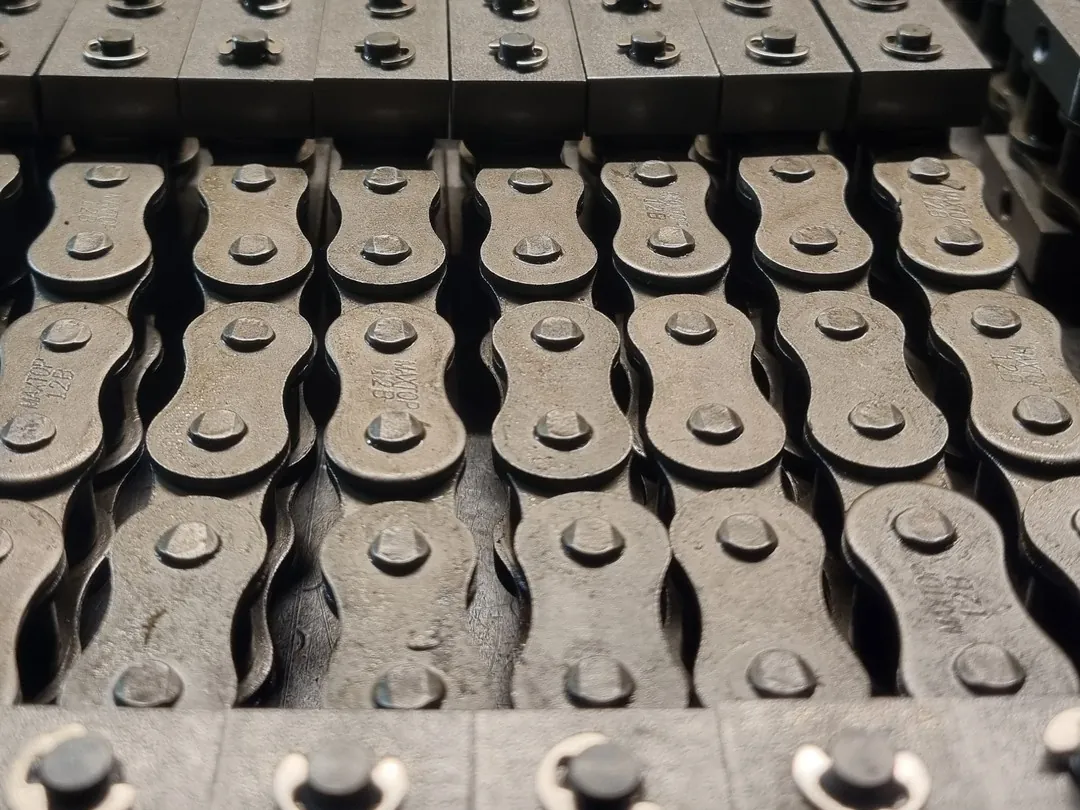
Standard BS, ANSI and double-pitch roller chain with attachment links fitted at the spacing, on the side and in the quantity your machine needs. Send the drawing, the sample or a photo. We build it up in our Malvern workshop and keep the spec on file.
What we need to quote
- Chain size or pitch — the number stamped on the plate, or the pitch if there isn't one. How to identify a roller chain shows the three measurements.
- Attachment type — the designation (A1, K1, SK1…) if you know it; a sketch or a photo if you don't.
- Spacing — every pitch, every second pitch, or the pattern along the chain.
- One side or both — which side of the chain carries the attachment.
- Length or quantity, and the environment — pitches or metres, and whether it runs wet, washdown, abrasive or food-side.
Don't know some of these? Send what you have: a photo and a tape measure usually get us there.
Every attachment chain we build is recorded: base chain, attachment, spacing, sides and length. The first order takes a drawing or a sample; every order after that takes a phone call.
Naming the attachment
The codes look cryptic; the system is simple. A letter for the shape, a letter for wide contour, and a number for the holes in each lug. If in doubt, skip the code and send a sketch.
| Designation | What it is |
|---|---|
| A1 · K1 | Bent lug with one bolt hole: A1 on one side of the chain, K1 on both sides. The workhorses of the range, on BS, ANSI and double-pitch chain. |
| A2 · K2 · SA2 · SK2 | Two-hole versions, on the double-pitch conveyor chain range. |
| SA1 · SK1 | Straight lug in line with the plate: SA1 one side, SK1 both sides. For fixings that mount side-on rather than on top. |
| WA1 · WK1 · WA2 · WK2 | Wide-contour bent attachments: the lug is formed as a full-width plate rather than a narrow tab, for bigger platforms and heavier fixings. One hole (WA1/WK1) or two (WA2/WK2). |
| WSA · WSK | Wide-contour straight versions of the same idea. |
| D1 · D3 · D5 | Extended pins, with no lug at all: one pin (D1) or both pins of the link (D3) reach out past the plate to carry rollers, spools or crossbars. D5 is the twin-extended-pin version on the double-pitch range. |
| GK1 | No lug and no extended pin: an enlarged fixing hole through the link plate itself, so a bolt passes straight through the chain. On the double-pitch conveyor range. |
| Hollow pin | An alternative fixing route: pins bored through their full length so rods and spindles pass through the chain itself — the hollow-pin range. |
| Welded & integral K types | On the heavier BS, ISO and FV conveyor ranges, K attachments come integral with the link or welded on, in K1, K2 and K3 patterns. |
Need the numbers? The full dimension tables for every attachment type (ANSI, BS/DIN and double-pitch) are in the attachment dimensions datasheet (PDF), taken straight from the catalogue.
Every pitch, every second pitch, or your pattern
Spacing sets the attachment count, and the attachment count sets most of the cost: every second pitch is roughly half the attachments of every pitch on the same chain. The pattern also has to come out even where the loop closes, which can decide the pitch count of the whole chain: how chain is supplied and joined covers it.
Attachments go on one side or both, and the chain still has to run on its sprockets when it is built — matched sprockets are supplied to run with the finished chain.
Builds we do
A recent one: a sawmill transfer deck running 16B-1 with WK2 wide-contour attachments every second pitch — 984 pitches of it, built up in Malvern and delivered ready to fit. The line it went onto moves cants between saws all day; what the customer reorders now is a part number and a quantity, not a survey.
The same job in miniature happens every week: packaging flights on double-pitch chain, elevator webs on agricultural machines, extended-pin builds carrying rollers and spools. If it bolts to a chain, it has probably been across our bench.
Flights, scrapers, brackets and profiles of your own design are custom work we do in-house — same workshop, same spec-on-file promise.
Carbon steel, stainless steel, plated
Carbon steel is the standard build. For washdown and corrosive lines the ranges run in stainless steel (SUS 304), including stainless steel attachment versions, the usual choice for food and hygiene-critical lines. Nickel-plated roller chain covers moderate corrosion resistance, and zinc-plated components are available on the BS conveyor series. Where the line can't be lubricated at all, build the attachments onto self-lubricating chain.
Mixing requirements (say, stainless steel lugs on a carbon steel chain? Ask us; it is a build decision, not a catalogue lookup.
Attachment chain is a made-up assembly, built to order from the base chain we hold in UK stock, which is what makes odd spacings and one-off patterns normal work rather than a special order.
Straight answers
Can you fit attachments to chain we already have?
Usually, yes. If the chain is in good condition we can build attachment links into it, or supply matching attachment links to fit. Send the chain number and a photo, and if the chain is worn, we will tell you straight that a fresh build is the better job.
K1 or SA1: which do I need?
A bent lug (A or K type) gives you a horizontal platform above the chain to bolt a flight or slat onto. A straight lug (SA or SK type) gives you a vertical face in line with the chain. If the part sits on top of the chain it is usually a K type; if it fixes side-on, look at SA/SK. Not sure? Send a sketch of the part and we will name the attachment for you.
Do you supply loose attachment links?
Yes. Attachment links and attachment connecting links can be supplied to go into your existing chain. Tell us the chain number and the attachment designation, or send a sample link to copy.
Can you match an old drawing or a worn sample?
Yes, this is routine work. Send the drawing however old it is, or the worn chain itself. We measure it, identify the base chain and the attachment, and quote the replacement built up and ready to fit.
How do I reorder?
Once we have built your chain, the full specification (base chain, attachment type, spacing, sides and length) stays on file. Reordering is a phone call or an email: a part number and a quantity.
Send the drawing, the sample or the photo.
We'll build it, keep the spec on file, and the next one is a part number.